
When to replace a coffee machine water filter
Author: AMT SerwisUpdated:
Take care of the water you use to brew coffee in your automatic machine. Find out how often the water filter should be replaced so you can enjoy delicious, aromatic coffee and protect your machine from breaking down.
An automatic coffee machine is a remarkably convenient appliance for making coffee on demand. It works by automatically dosing the right amount of coffee, milk and other ingredients, then preparing the drink to the user's preferences. That is how an automatic machine can produce many different kinds of coffee — espresso, cappuccino, latte — with consistent quality and taste. But to be sure the coffee it makes is perfect, it is worth knowing what else, besides the appliance itself, influences the final taste and aroma of the brew.
What affects the taste of coffee from a machine
The first thing that comes to mind is, of course, the quality of the beans. That is the fundamental factor, but not the only one. The taste of coffee from a machine depends heavily on several others:
- grind size — the finer the grind, the more intense and pronounced the taste
- water temperature — too low and the coffee will be bland and lacking aroma; too high and it will turn bitter and unpleasant
- the coffee-to-water ratio — getting the proportions right is key to a perfect cup, so it is worth sticking to the manufacturer's recommendations
- brewing time — coffee brewed too briefly can be bland and lacking aroma, while coffee brewed too long can turn bitter and unpleasant
- water quality — the water used should be clean and free of contaminants so that it does not interfere with the taste
How to look after the water quality in your machine
The simplest way to achieve optimal water hardness is to use filters. Hard water — which is what most of us have — can affect the taste of coffee for the worse. Water with a high hardness level contains more minerals such as calcium and magnesium, which settle inside the machine and restrict the flow of water through the coffee. That in turn changes the taste: the coffee comes out less aromatic, sour, or with an unpleasant metallic note. What is more, limescale is one of the most common causes of faults in automatic coffee machines. So to avoid these problems it is worth making sure the water you use has an optimal hardness — and a water filter is what makes that possible.
What a water filter in a coffee machine does
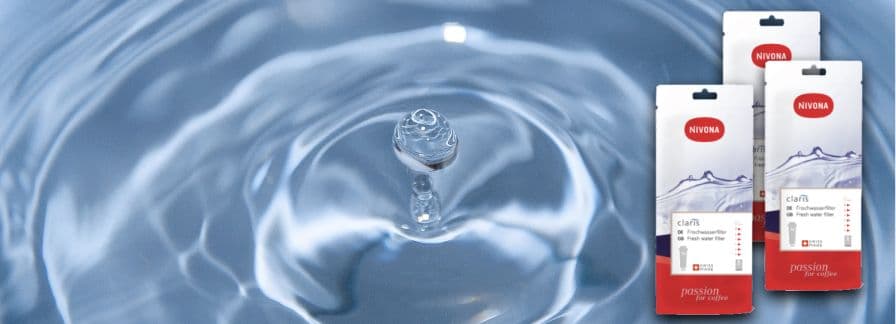
Water filters in coffee machines clean the water used for brewing. The water is stripped of contaminants, hard mineral content, and the smells and tastes that would otherwise affect the coffee. As mentioned, filtered water is also better for the machine itself, because it prevents limescale and other deposits building up inside the appliance, allowing longer and trouble-free use. Filters are particularly useful if you run your machine on tap water, which often contains hard minerals and other contaminants that can spoil the taste of your coffee.
How a water filter works
Water filters consist of a chamber holding a filter cartridge of some kind. Cartridges can be made from various materials, such as activated carbon, polypropylene, polyester or other filtration media. The composition varies between manufacturers and filter types, but they all do the same job: they clean the water by removing contaminants, hard mineral content, and unwanted smells and tastes. Some filters also contain additional ingredients, such as minerals, that can improve the quality and taste of the water.
How to change the water filter in an automatic coffee machine
Changing the water filter is a fairly simple job you can do yourself without calling on a service centre. The filter sits inside the water tank. To replace it, first disconnect the machine from the mains. Then you can get started. Begin by taking the water tank out of the machine. If there is water in it, pour it away. Start the replacement by removing the used filter, if one was fitted. Then wash the tank and fit the new filter. How the filter is fitted depends on the model: some screw in — you will find this arrangement in Krups machines, for example — while the filter in a Saeco machine is pushed into place. The manufacturer should supply instructions covering filter replacement for your particular model, and we recommend reading them before you start. Once the new filter is correctly fitted, refill the water tank, put it back in the appliance and reconnect the power. Then comes the last step: rinsing. Most appliances have a dedicated programme that runs an automatic rinse. If yours does not, do it manually — we suggest not using the water from the first tank for brewing, but pouring it away.
How often to change the water filter
How often the filter needs changing depends above all on the quality of the water you use and on the model of your machine. Some manufacturers express filter life in cups of coffee (anything from 150 to 600 cups per filter), while others give a volume of filtered water (50 litres, for example). Either way, on average the water filter in an automatic machine should be replaced every two months. That said, we encourage you to check your machine's manual, where you will find the manufacturer's precise guidance.
Do you still have to descale a machine that uses a water filter?
Yes. Even if you use a water filter, the appliance still needs descaling regularly. Filters effectively reduce the mineral content of the water, but they do not remove it entirely, so there is still a risk of deposits and scale forming in various parts of the machine. Water filters are an important element and genuinely help you look after both the technical condition of your machine and the taste of your coffee — but using them does not exempt you from the other maintenance the appliance needs.